
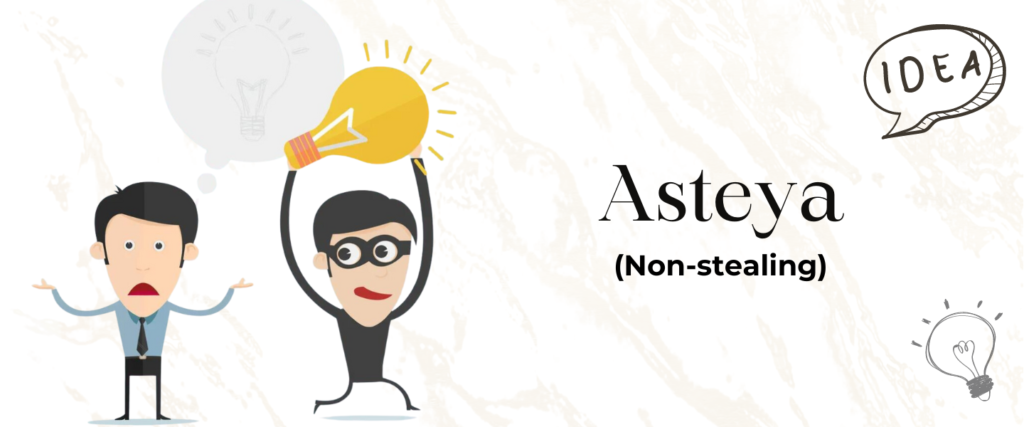
The word asteya is derived from the Sanskrit word “steya,” which means to steal or rob. By adding the prefix “a- “it becomes asteya, which means not to steal or rob or not to take what belongs to others without their permission. Asteya is a basic human value; it is simple and straightforward but so difficult to practice.
Why am I saying it is difficult to practice? Let me give you an example. In school, tuition, classes or college, if we have forgotten, say, a pencil, rubber or pen, and we take it from our friend to write or erase, at times, we start liking the same as we like the smoothness or grip of the same and we keep it with us without returning, and we tell ourselves that we will give them back after 2/3 days. Thereafter, many times, we never return those pencils, pens, sharpeners or erasers. These things were given to us by someone, and it was our moral duty to return them with thanks to the person who gave them to us. But instead of returning the same to its owner, we keep it as we fell in love with it, or we start liking it and want it to be in our possession always, and hence, we never return it. This is a small mistake which we make, and without realizing it, we start “steya”, i.e. taking things belonging to someone and never returning.
Similarly, when you were the last to leave your classroom, and you came across someone who had forgotten his/her pen, compass, or other valuable thing, you picked it up thinking you would return it, but alas, you either forgot or fell in love with that compass or pen, and the thing never reached its owner.
We also, at times, find, say, five rupee coins or Rs.10 notes while walking in a market. We immediately pick that up and put that in our pocket while ensuring no one has seen us, as if God has sent us the gift!
When we were kids, my mother always used to teach us the values of life through stories and day-to-day practical examples. She used to check our school bags daily and arrange our books in the school bag as per the classes scheduled the next day. In case she used to see any rubber, pencil, scale pen, etc., that did not belong to us, she used to tell us to give it back to the person who had given it to us. We were taught not to take anyone’s belongings without asking them and return them as soon as possible. Even if we found anything in class and did not know their owner, she always told us to deposit it with the school admin.
We were kids and, at that time, did not know that she was checking on us and ensuring that we learned the moral values of non-stealing.
When we enter professional life and if we are working in any firm or company, we start bringing home office stapler, scale, files, and folders and take printouts/copies of all our personal important documents from the office printer. Sometimes, we do all the project work for our kids from the office resources. Is it not stealing? Whenever these thoughts come to our mind, we just ask our brain to shut off as we can’t tolerate or withstand the truth. Instead, we try to justify every wrong action of ours by pointing out similar stories of our seniors and colleagues who take office resources for granted and get their all personal work done from office resources. But in our heart, we know, two wrongs do not make a right.
So many times, we have come across in our professional career where we would have stolen someone’s idea, work, thoughts, or solutions and represented it as our own to get brownie points in front of our seniors. Doesn’t it sound so familiar right? To take someone’s idea or thoughts without acknowledging that it is not your idea is a sin. To take credit for someone else’s work or idea is a moral crime. We never in our dream thought that this is also the worst form of stealing. This, to me, is the highest form of loot. This not only dents our moral values but also damages our spiritual growth. But by the time we realise that it is too late and we never recover from it. We only realise when someone steals our credit/ideas and we don’t know what to do and/or how to react. We all need to achieve Asteya in this, too.
We are currently in an era where we are even facing identity theft. Those who are Hindi film music lovers would know or would have come across so many songs, tunes and lyrics being copied or, to say, inspired in Hindi movies by songs of other artists, countries and languages without giving any credit to the original composer or music director. This also kills originality, which is not good for creativity and causes injustice to the original creator. At times, Intellectual Property Rights (IPR) disputes are also fought on the grounds of someone stealing somebody else’s concept, idea, technology, logo, brand, story, etc.
Asteya (non-stealing) is the third of the five Yamas (Ethical Rules or, one can say, Social Discipline), as per Patanjali Yogsutra.
In the words of the great master Lao Tzu, “Be content with what you have; rejoice in the way things are. When you realize nothing is lacking, the whole world belongs to you.” This is the true spirit of Asteya.
What is the root cause of Steya? As Radhika Gupta of Satvic Yoga says – “The moment we feel a sense of “lack” in our life, desire, want, and greed emerge. We begin to look for something to fill that void – that “empty sensation” and often feel as though everyone else has what we want. And we crave what others have so much that we start to steal. What has started as just an act of stealing of small things, when it becomes a big moral dent on our character, we don’t know.
We need to practice Asteya in the real sense and beyond physical stealing. It is not easy. It requires self-discipline and practice. It comes with self-confidence and confidence in God that we are already good enough and have enough. It requires constant support from our friends and well-wishers.
As Mahrshi Patanjali says “अस्तेयप्रतिष्ठायां सर्वरत्नोपस्थानम्”. Those who are deeply rooted (pratiṣṭāyāṁ) in non-stealing (asteya) have access (upasthānam) to all (sarva) jewels (ratna).
May God bless you with all the jewels of all the virtues, particularly five Yama, i.e. Ahiṃsā (non-violence), Satya (Honesty), Asteya (not stealing), Brahmacharya (adhering to the brahman, a disciplined life) and Aparigraha (not coveting others’ wealth, non-avarice). To master one yama, it may take one human life. As Sanskrit Subhashita says
शनैः पन्थाः शनैः कन्था शनैः पर्वतमस्तके ।
शनैः विद्या शनैः वित्तं पञ्चैतानि शनैः शनैः ॥
(Slowly the journey reaches its end; it takes time to become a Yogi. Climbing a mountain or acquiring knowledge or obtaining money is also achieved in due course of time by constant effort i.e. slow and consistent efforts)
All the best towards your journey in mastering Asteya.
As Swami Vivkekananda has said “Arise awake and stop not till the goal is reached.” Practice, practice and practice asteya and one day we will achieve and master it. Till then may God bless you with awakening.
True
Thanks Vijay
Superb explanation
Thank Shiv
Thank You Nimesh Bhai. It was so real and a simple act which we can all practice in our day to day life to become a better human being. A value which if practiced on daily basis, makes every one live in harmony love and respect.
This value is also reflected in “you” as a human being which we have seen you have always practised in your professional and personal life.
God Bless you and your family always
Thanks Hiren for your kind words. Sometimes instead of thinking and acting in a simple way, we complicate it by overthinking and judging others only and not looking within.
Very true sir, stealing can be at mental, emotional levels too which is still not recognised like at mental level stealing attention of someone, at emotional levels stealing sympathy by presenting ourselves as helpless.
Being human we all have long way to go…but true to start with self recognising 👌👍
Thanks Trupti for adding your invaluable perspective. Really appreciate.
Awesome Blog Sir
Thanks Satish
Great lesson. We all know it but knowingly/unknowingly get into it and you are right that we know it is wrong and sometimes realize it , but later may be when it happens with us. Life it very simple and being honest and truthful does not cost much. Happy to read. Keep writing.
Thanks Amit. This is all I have learnt by making mistakes and by the time we realise, at times it is too late. Need to have our eyes open, soul sensitive and work on ourselves constantly to improve, as you are your own judge.
Lovely insight. Simple yet powerful!
Thanks Darshika
Beautifully penned Nimesh.
Thanks Gayatri
Sir your blog beautifully delves into the essence of Asteya, highlighting its root cause and the transformative power it holds. It’s a reminder that Asteya isn’t just about refraining from physical theft but also addressing the deeper sense of lack within ourselves. The journey toward mastering Asteya indeed requires self-discipline, confidence, and support, as you aptly mentioned. Your use of quotes from Radhika Gupta, Maharshi Patanjali, and Sanskrit Subhashita adds depth and wisdom to your message. Overall, it’s an inspiring call to practice Asteya in its truest sense and to embark on the journey of self-improvement and virtue. Keep spreading such insightful wisdom!
Thanks Dharmendra for your kind words and capturing the essence of the blog. As Smita has said we need to remind ourselves that we are good enough and we have enough.
Well articulated sir.. each one of us can ralate to either of the instances..
These simple examples can lead to build concrete morals in our life and teach us to be content with what we have.
A lovely oneliner takeaway – we are good enough and we have enough
Thanks Smita for the beautiful one liner – we are good enough and we have enough. This captures the essence of the blog so well. We need to practice Asteya day in and day out till it becomes our habit.
Great topic Nimesh. Well explained with real world examples. Lot to learn and apply in our day to day activities.
Thanks Chandra
Awesome 👌 amazing to read the articulation,
so simple and strong message. Kudos 👏
Thanks Anmol
Great subject explained in very simple language.
One step further, even coping some one idea or Goal become some time stealing.
Through practice of ASTEY, creative ideas and thoughts will emerge and that will lead to great inventions.
Those who can see invisible can only do impossible.
By this way, we can create strong society and nation too.
Once again, very very practice subject explained nicely by Nimeshbhai.
Thanks Nirmal. You have rightly said “Those who can see invisible can do impossible”.
Instinctively we are driven with desire to possess and we want it now…so we steal.
Question is why Maharshi has used word ‘astey and not nispruha’…?
I think He has shown the way to attend Nispruha’ by way of astey.
Maharshi has caution towards our instinct to be able to be true Yogi …
Thanks Bharat for your insight and sharing wisdom of Maharshi. Asteya and Nispruha – your interpretation is thought provoking.